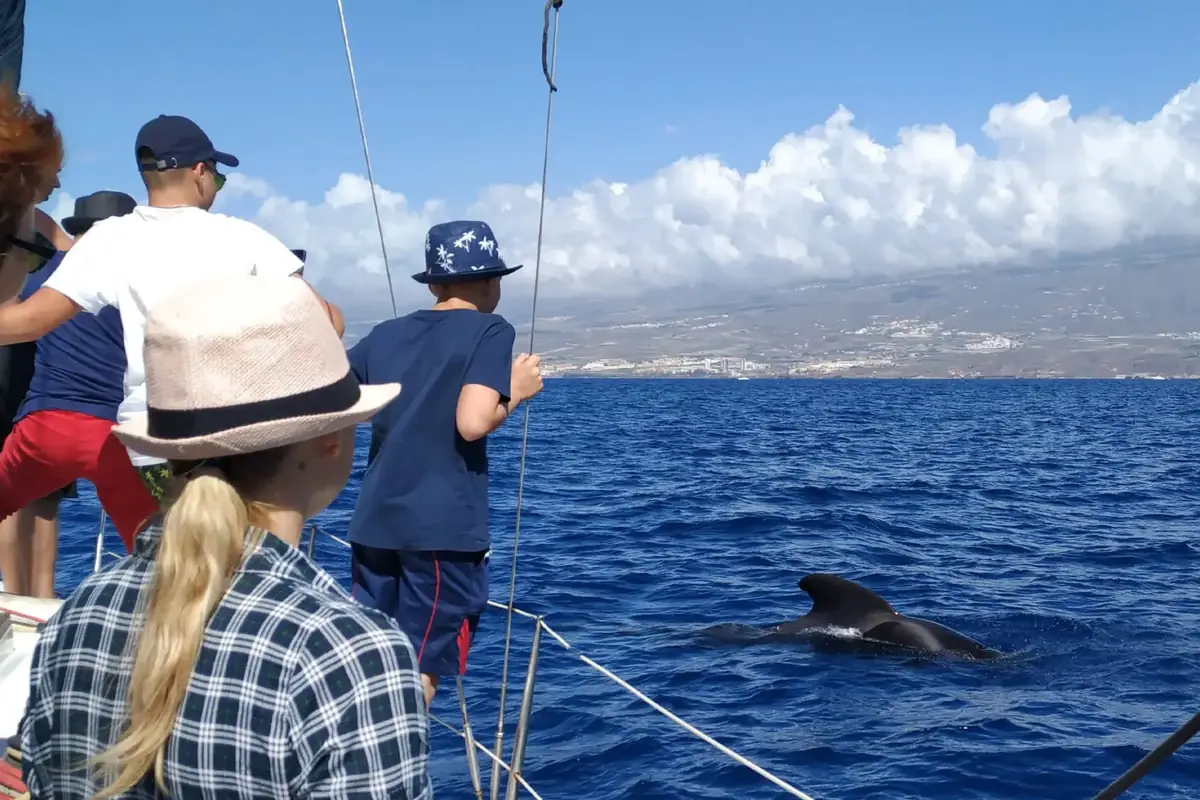

Yes, you can go whale watching in Tenerife with children of any age, and it is one of the easier wildlife trips to do as a family. The resident pilot whales live a short sail from Costa Adeje, the trip lasts 3 hours, and on a sailing yacht with no more than 11 guests a child is never stuck behind a crowd at the rail. What decides whether the day goes well is simple: the right departure time, good sun protection and a plan for seasickness.
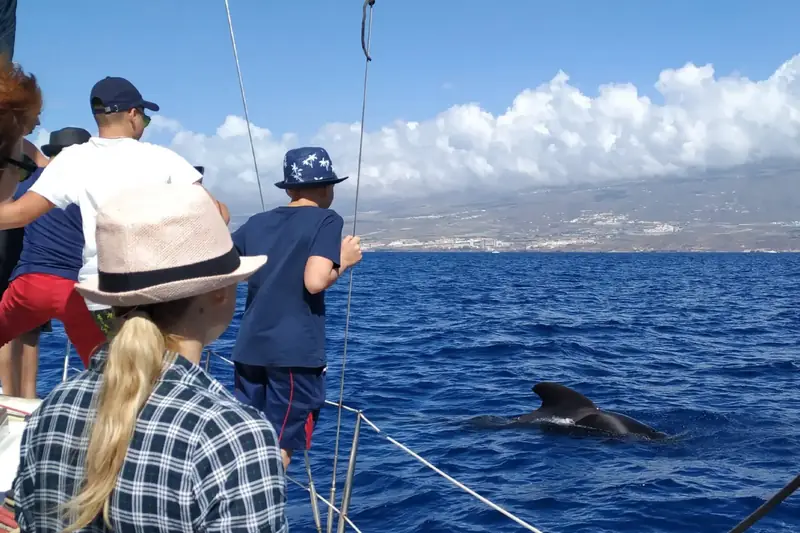
Is there a minimum age?
Not on our trips. Families with children of all ages sail with us, babies included, on both shared and private trips. On the small-group trip the child fare of €39 applies from 0 to 10 years; the adult fare is €49.
Age matters less than supervision. Children must stay with an adult at all times, so think honestly about how many small children each adult can look after on a moving boat.
- Babies and toddlers usually cope well with the motion, but they need shade, and a yacht has no room to crawl or run. One adult will have their hands full.
- Children of about 4 to 10 tend to get the most out of it: old enough to spot a fin themselves and to remember the day.
- Teenagers usually enjoy the swim and snorkel stop as much as the whales.
Safety on board
Life jackets are included on every trip, and children’s life jackets are on board — just ask the crew when you step on. It is worth telling us the ages of your children when you book.
Two of our yachts are worth knowing about:
- Lina Siete has a clear deck, a protected cockpit and a calm motion under sail, and is easy to move around on.
- Mizendoha has a boarding ramp and an accessible toilet. If someone in your family needs the ramp, tell us when you book.
A few rules are easier to agree on the quay than at sea:
- stay seated when the skipper asks, especially while leaving and entering the marina;
- hold on with one hand when moving around the deck;
- never lean over or climb on the rail;
- when the skipper speaks, everybody listens.
Which departure time is best with children?
We sail every day at 09:30, 12:30 and 15:30. The whales do not keep a timetable, so choose by the sea, the sun and your child’s routine.
| Departure | Good for | Keep in mind |
|---|---|---|
| 09:30 | Young children, anyone prone to seasickness | Usually the calmest sea, and you are back before the strongest sun |
| 12:30 | Families with a slow morning | The sun is at its highest: shade, hats and sunscreen are essential |
| 15:30 | Children who nap after lunch, older kids | Softer light; in mid-winter the return is close to sunset, so bring a jacket |
If you can choose freely, take the 09:30 trip with small children.
Seasickness: what really helps
According to the US Centers for Disease Control and Prevention (CDC), children aged 2 to 12 are especially susceptible to motion sickness, while babies and toddlers are generally not affected. So it is the primary-school child, not the baby, you should plan for.
The UK’s National Health Service (NHS) recommends simple measures that work well on a yacht:
- sit in the middle of the boat, where it moves least;
- look at a fixed point such as the horizon — or La Gomera across the channel;
- stay out in the fresh air;
- keep children busy with talking, songs or spotting games;
- no reading and no screens;
- avoid a heavy meal just before sailing.
Ginger, for example as biscuits, may also help. If your child is often travel-sick, ask a pharmacist before the trip: the NHS notes that there are dissolvable tablets for children, while patches are only for children over 10.
South-west Tenerife lies in the shelter of the island from the north-east trade winds, so the sea here is often calmer than on the north coast. It is still the open Atlantic, and some swell is normal.
Sun and warmth
The World Health Organization (WHO) describes children as particularly vulnerable to ultraviolet radiation and advises sun protection whenever the UV index reaches 3 or above. Water reflects UV as well, so on a boat the sun arrives from above and from below, and the sea breeze hides how strong it is.
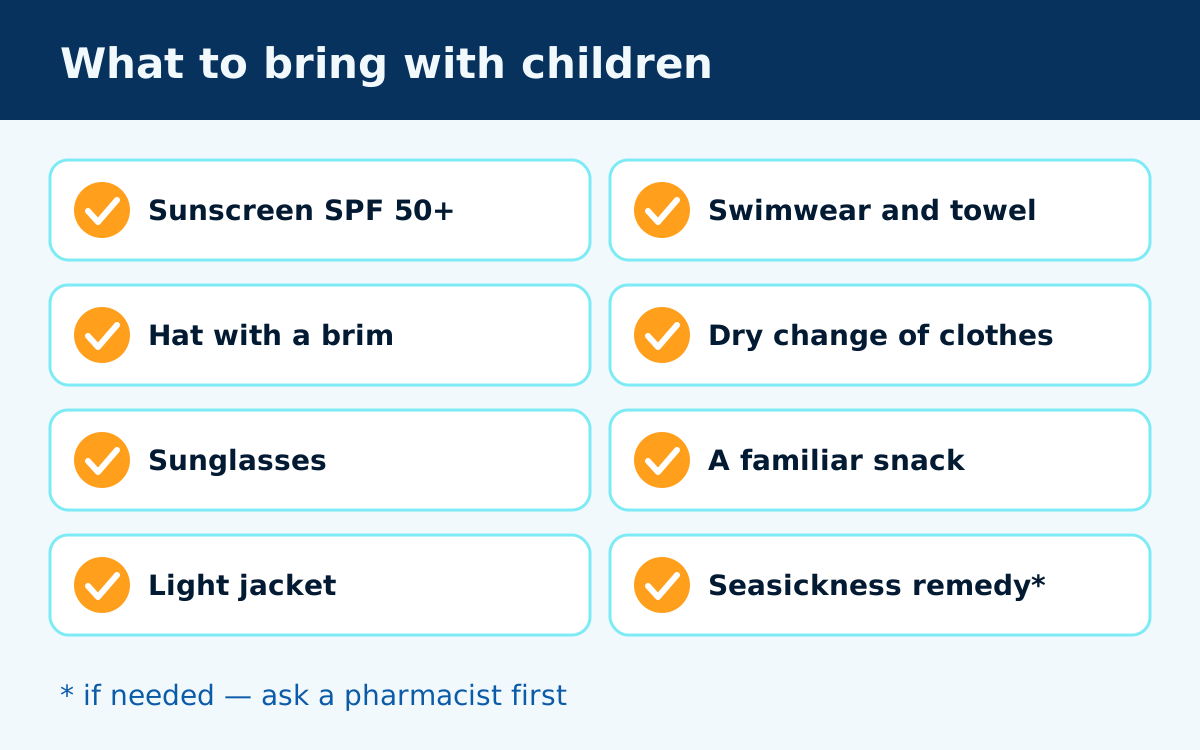
- Use a high-factor, broad-spectrum sunscreen. Ireland’s health service (HSE) recommends SPF 50+ for children, applied about 20 minutes before going out and again every 2 hours and after swimming.
- Babies under 6 months should be protected mainly by shade and clothing.
- A brimmed hat that stays on in the wind, sunglasses and a top that covers the shoulders do more than cream alone.
It is also cooler on the water than on land. A light jacket is useful in any month.
What children actually see
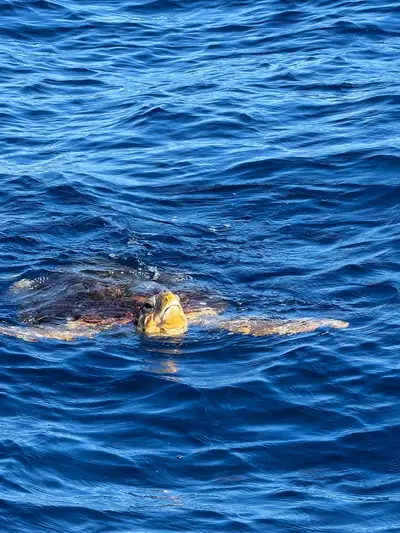
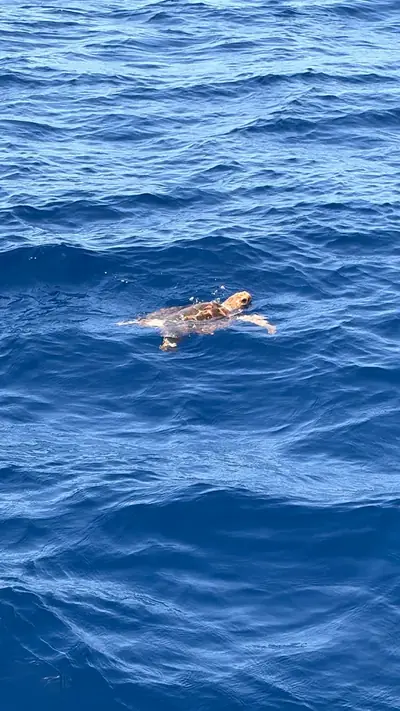
We meet short-finned pilot whales on almost every trip and bottlenose dolphins on about half of them; sea turtles appear sometimes, mostly in summer. These are wild animals and no sighting is guaranteed. Say so before you sail — it saves tears.
Pilot whales are good “first whales” for children. During the day they often rest at the surface or travel slowly, so even a small child has time to find the dark fin. Calves usually swim tight against their mothers.
Authorised boats must stay at least 60 metres from the animals and spend no more than 30 minutes with one group, and nobody may feed them or swim with them. Children accept this easily if you explain it: we are visitors in the whales’ home.
To keep young spotters interested:
- count the fins in the group;
- decide who it is: a black animal with a round head is a pilot whale, a grey one with a beak is a bottlenose dolphin;
- look for the smallest fin — it may be a calf.
The swim stop and the food
After the whales, when the sea allows, we anchor near Diego Hernández beach for about 30 minutes of swimming and snorkelling. Snorkel gear is on board. Swimming is optional, and children should only go in with an adult; a child who is not a confident swimmer can wear a life jacket in the water.
The sea is about 18 °C in February and March and about 24 °C in September and October (approximate values). Small children cool down quickly, so pack a towel and dry clothes.
A sandwich (regular, vegan or gluten-free), fruit, soft drinks and water are included. If your child is a fussy eater, bring a snack they know.
Shared or private trip with a family?
The small-group trip costs €49 per adult and €39 per child aged 0–10, so two adults and two children pay €176. You share the yacht with a few other guests, never more than 11 on board in total.
A private trip costs €399 for the whole yacht, for up to 11 guests including children and babies. It suits families who want space and their own rhythm, and for two families travelling together the difference in price becomes small.
Two practical tips. Book early in your holiday: if the captain cancels because of the weather, you choose a new date or a full refund. And if you have no car, hotel pick-up is available from €10 per person between Los Cristianos and Playa Paraíso.
Travelling in the school holidays? Our half-term guide has the 2026/27 holiday dates and the weather in Tenerife for each break.
Book a family whale-watching trip
- Small-group whale watching — 3 hours from Puerto Colón, Costa Adeje, daily at 09:30, 12:30 and 15:30. €49 per adult, €39 per child (0–10), up to 11 guests.
- Private whale watching — the whole yacht for your family, €399 for 3 hours, up to 11 guests.
- When to go — our month-by-month guide.
Sources: CDC Yellow Book, “Motion Sickness”; NHS, “Motion sickness”; World Health Organization, “Ultraviolet radiation” fact sheet; HSE (Ireland), “Preventing sunburn in babies and children”; Hello Canary Islands (official tourism) and Canary Islands whale-watching regulations.