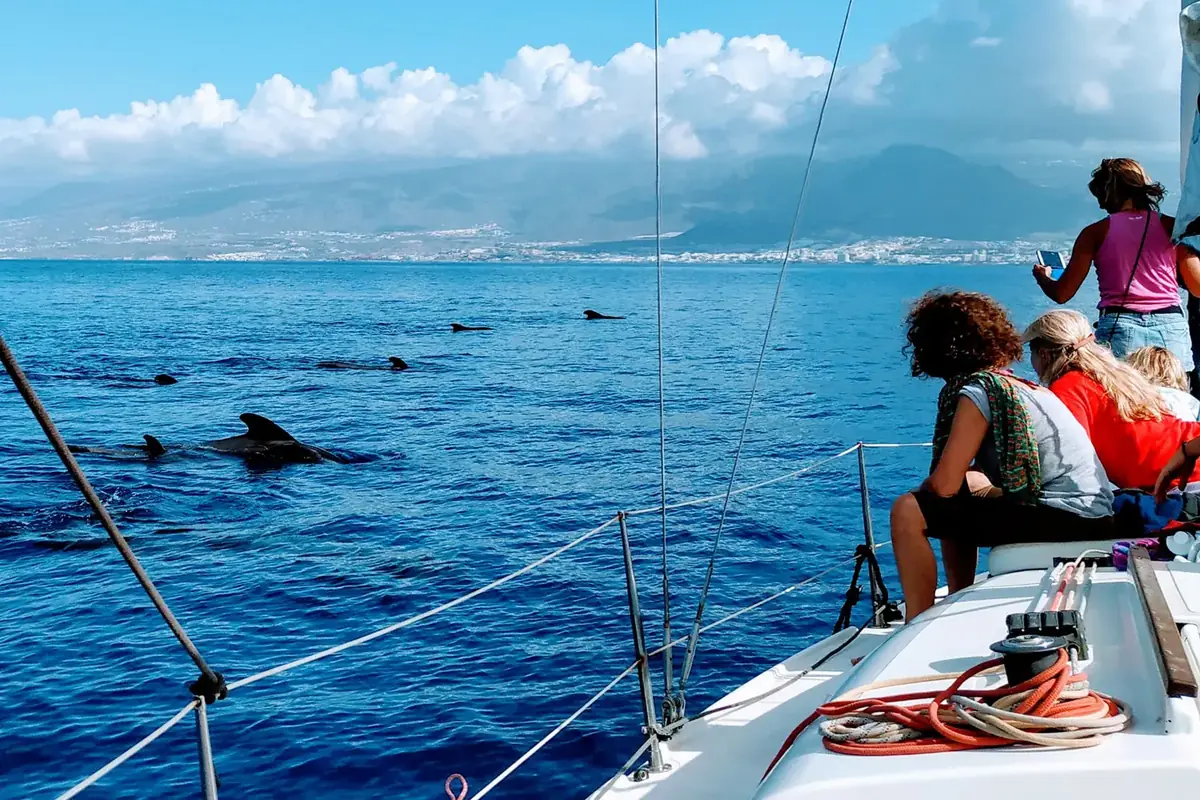

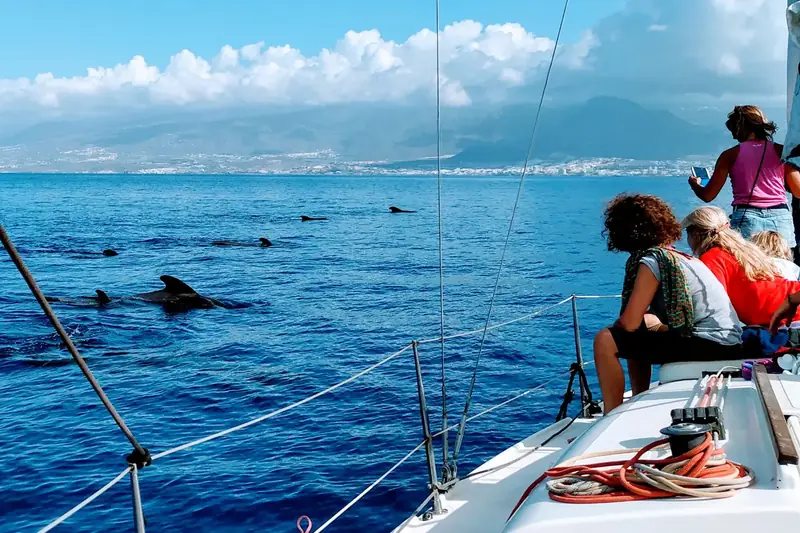
If you take a boat out from Costa Adeje, the animals you are most likely to meet are not a passing migration but local residents. A community of short-finned pilot whales (Globicephala macrorhynchus) lives off the south-west coast of Tenerife all year — one of only a handful of resident pilot whale populations known in the world.
This guide explains who these animals are, why they chose this stretch of ocean, and how to see them without disturbing them.
A dolphin that looks like a whale
Despite the name, pilot whales are dolphins. They belong to the family Delphinidae, and the short-finned pilot whale is the second-largest dolphin on the planet after the orca.
You recognise them by:
- a dark, almost black body;
- a round, bulging forehead (the “melon”), much larger in adult males;
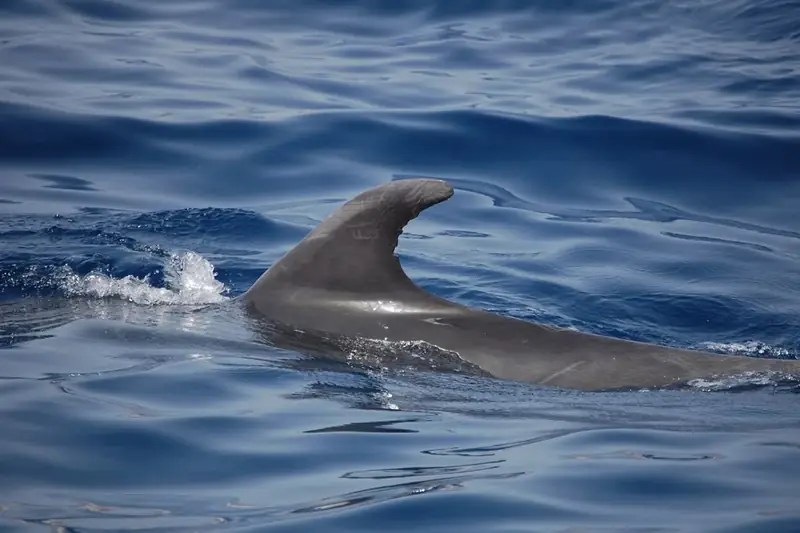
- a wide, curved dorsal fin set forward on the back.
Adult males usually reach about 5–5.5 metres and can weigh more than a tonne. Females are smaller, around 3.5–4 metres. Females can live to about 60 years, males usually to 35–45. A pregnancy lasts around 15 months, so calves are precious — and you will often see them swimming tight against their mothers.
Their home: the deep channel between Tenerife and La Gomera
The secret of Tenerife is depth. Off the west and south-west coast, the sea floor drops away steeply, so very deep water lies just a few kilometres from the shore. That deep water is where the pilot whales find their food.
Much of this area is protected as the Teno-Rasca marine Special Area of Conservation (ZEC ES7020017), declared in 2011. It covers around 695 km² along the coast of Buenavista del Norte, Santiago del Teide, Guía de Isora, Adeje and Arona. Up to 22 species of cetaceans have been recorded there, and it is also home to resident bottlenose dolphins and loggerhead sea turtles.
The wider sea area between Tenerife and La Gomera has also been recognised by the World Cetacean Alliance as a Whale Heritage Area, and in 2023 it was named the “world kilometre zero” of the pilot whale.
The south-west of the island also lies in the shelter of Tenerife from the north-east trade winds, so the sea here is often calmer than on the north coast — good news for the whales and for your trip.
Family life: a society led by mothers
Pilot whales are deeply social. They live in stable family groups — off Tenerife usually 10 to 30 animals, sometimes more — built around related females. Daughters tend to stay with their mothers for life, while adult males travel between groups.
Researchers studying the Tenerife community estimate it at around 400 individuals. Each animal has a unique dorsal fin, with nicks and scars that scientists use to recognise individuals in photographs, year after year.
Cheetahs of the deep: how pilot whales hunt
What you see from the boat — slow, calm animals resting at the surface — is only half the story.
In a study of 23 pilot whales tagged off Tenerife, scientists from the University of La Laguna and the Woods Hole Oceanographic Institution found that they hunt with deep sprints: they dive for around 15 minutes, descend to about 500 metres, then chase their prey at up to 9 metres per second, sometimes as deep as 1,000 metres. Their favourite prey is believed to be large squid. The researchers called them the “cheetahs of the deep sea”.
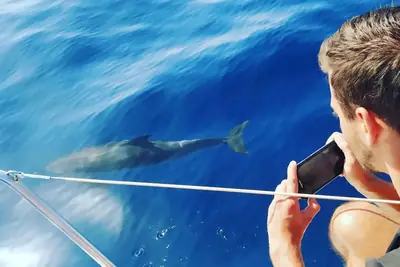
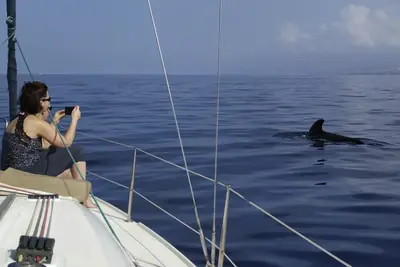
Much of this hunting happens in the dark depths and at night. During the day pilot whales are often seen resting at the surface, lying almost still with only the fin and back visible, or travelling slowly together. That is the behaviour you are most likely to watch from a yacht.
How we watch them responsibly
The Canary Islands have strict rules for whale watching, and only authorised boats (the Barco Azul licence) may take visitors to watch cetaceans. On every trip we:
- keep at least 60 metres from the animals and approach slowly from the side, never head-on;
- stay no longer than 30 minutes with the same group;
- move away if the animals show signs of disturbance;
- never feed the animals or let guests swim with them.
Sailing helps: a quiet yacht with a small group of up to 11 guests is far less intrusive than a large, noisy boat.
No sighting can ever be guaranteed — they are wild animals. But because the pilot whales live here all year, they are seen on the great majority of our trips.
After the whales: a swim at Diego Hernández
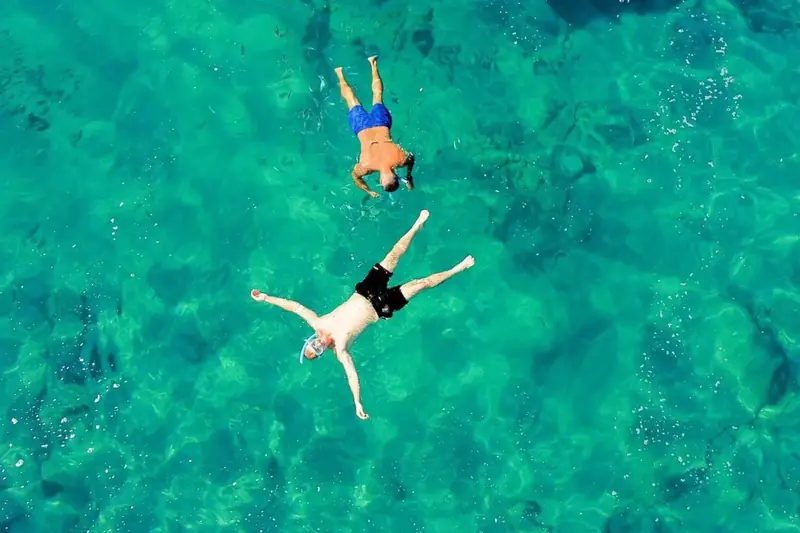
On our 3-hour trips from Puerto Colón, after time with the whales we sail back along the coast and, when the sea allows, anchor in the calm bay at Diego Hernández beach for about 30 minutes of swimming and snorkelling. Masks and snorkels are on board, together with sandwiches, fruit and drinks.
See the pilot whales of Tenerife
- Small-group whale watching — 3 hours from Puerto Colón, Costa Adeje, at 09:30, 12:30 and 15:30. €49 per adult, up to 11 guests.
- Private whale watching — the whole yacht for your group, €399 for 3 hours.
- From Las Galletas — private trip on IVO in the far south, €325 per yacht.
Sources: Teno-Rasca SAC data sheet (Spanish Ministry for the Ecological Transition); Aguilar Soto et al., “Cheetahs of the deep sea”, Journal of Animal Ecology, 2008; World Cetacean Alliance, Tenerife–La Gomera Whale Heritage Area; Canary Islands whale watching regulations.