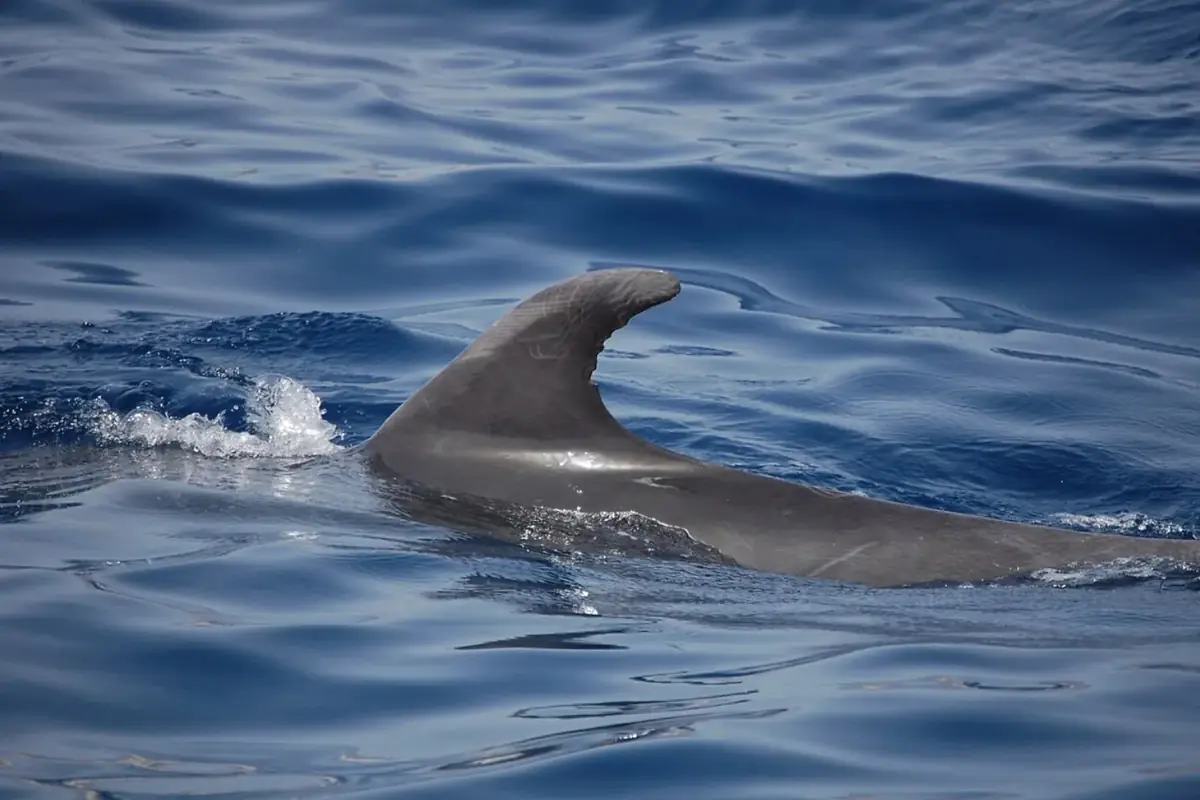

Barco Azul (“Blue Boat”) is the official flag of boats that are authorised to take tourists whale and dolphin watching in the Canary Islands. It is issued by the Government of the Canary Islands together with the whale-watching authorisation, it must be renewed every year, and — confusingly — the flag itself is yellow. If you see it on a boat in Puerto Colón, Los Cristianos or Los Gigantes, that boat is allowed to approach the whales and has agreed to do it by the rules.
Here is what stands behind the flag, what it does and does not promise, and how to check a boat before you book.
Where the flag comes from
The Canary Islands first regulated whale watching by decree in 1995. The current rules are in Decree 178/2000 of the Government of the Canary Islands, published in the official gazette in October 2000, which replaced an earlier decree from 1995.
The decree says that organised whale watching for tourists needs a prior administrative authorisation, and that every authorised boat must carry, “in a visible place”, a distinctive in the form of a flag called “Barco Azul / Blue Boat”. The flag is handed over with the authorisation and again at each renewal.
Do not mix it up with the Blue Flag (Bandera Azul). That is an international award for beaches and marinas. Barco Azul belongs to one specific boat.
What a boat needs to get it
The authorisation is granted by the Canary Islands tourism department, after a binding report from the environment department. According to the decree, the operator has to provide, among other things:
- registration as a tourism business and the permit for passenger transport by sea;
- civil liability insurance for passengers;
- a financial guarantee deposited with the Canary Islands treasury, which can be used if the company is sanctioned;
- a specialised guide on board, accredited for cetacean observation;
- a basic ecological impact study of the activity.
The authorisation is valid for no more than one year. To keep the flag, the company has to apply for renewal, and the administration checks that it has no final sanction that suspends its activity. A copy of the authorisation must be on board at all times.
On top of the Canary rules, Spanish national law (Law 41/2010 on the protection of the marine environment) requires an authorisation from the Ministry for the Ecological Transition for whale watching in protected sea areas such as Teno-Rasca. In September 2023 the ministry announced a pause on new authorisations there while a study of how many boats the area can carry is completed — one more reason why the number of licensed boats is limited.
The rules a Barco Azul boat follows
The decree lists what counts as disturbing the animals. The Spanish Royal Decree 1727/2007 adds a “mobile protection space” of 500 metres around every whale or dolphin, and applies to every vessel, private boats included.
In practice, a licensed skipper:
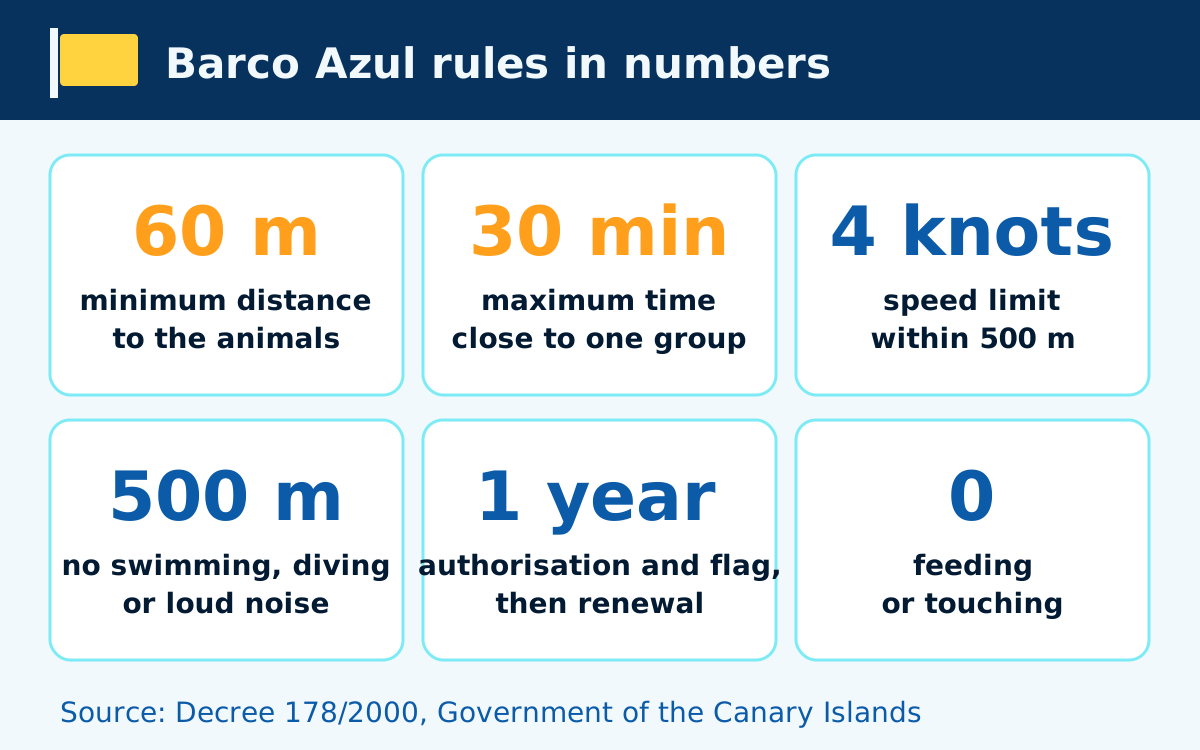
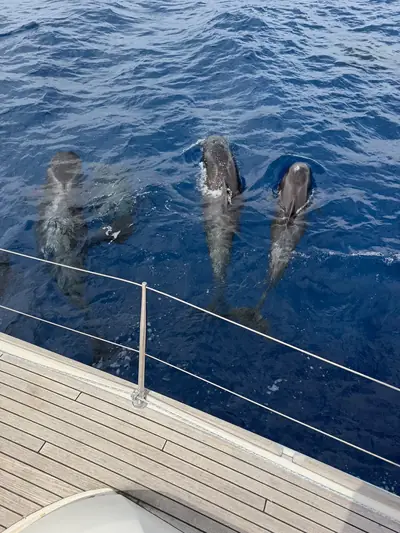
- stays at least 60 metres from the animals — if they come closer by themselves, the engine goes to neutral and the boat waits;
- sails at no more than 4 knots within 500 metres, and never faster than the slowest animal in the group;
- approaches gently from the side, at an angle of about 30°, never head-on, from behind or across their path;
- spends no more than 30 minutes close to the same group;
- shares the animals with other boats: at most two boats may be in the 60–300 metre zone at once, and the others wait farther out, in radio contact;
- never separates a group, and never gets between a mother and her calf;
- does not allow swimming, feeding, touching or loud noise near the animals, and throws nothing into the sea.
Jet skis may not be used to watch cetaceans at all within 500 metres. We explain the swimming ban in detail in Can you swim with dolphins in Tenerife?
What the flag does not tell you
Barco Azul is a legal minimum, not a quality rating. Two boats with the same flag can offer very different trips: one with a hundred passengers, one with ten. It says nothing about the size of the group, the length of the trip or how well the guide explains what you are seeing. And it is not a promise of sightings — these are wild animals, and no licence can guarantee them.
Some companies go beyond the legal minimum. Tenerife’s tourist board runs a voluntary Sustainability Charter for Whale Watching, whose signatories commit, for example, to carrying an accredited marine-environment interpreter and to not using loudspeakers within 500 metres of the animals.
How to check a boat before you book
- Look for the yellow flag on the boat itself, not just a logo on a website.
- Ask directly: “Is this boat Barco Azul authorised?” A licensed operator answers at once and names the boat.
- Read the offer. Promises of swimming with dolphins, touching the animals or “guaranteed” whales do not fit the rules.
- Check the kind of trip. A cheap private boat or jet-ski rental can legally show you the coast, but not take you to the whales.
- Then compare group size, type of boat and duration — our guide to choosing a port shows what really changes the experience.
Why it matters
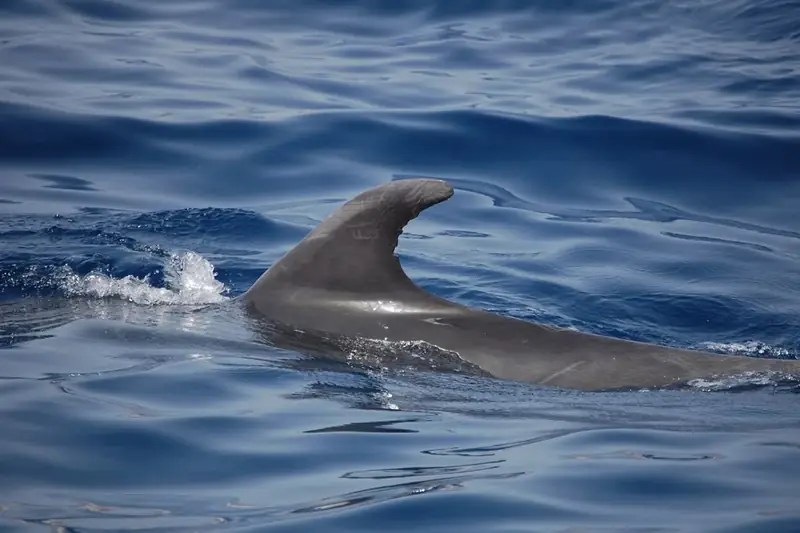
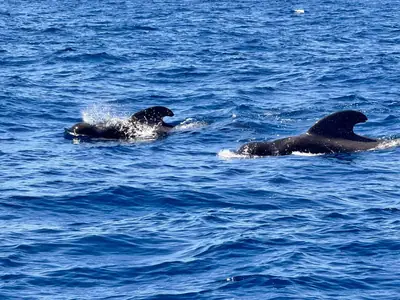
The sea off south-west Tenerife is home to a resident community of pilot whales and bottlenose dolphins that rest, feed and raise their calves here all year, inside the Teno-Rasca protected area. They meet boats every single day. Distance, low speed and time limits are what allow them to keep resting and nursing while we watch — and what keeps them here for the next visitors.
Our boats and the Barco Azul licence
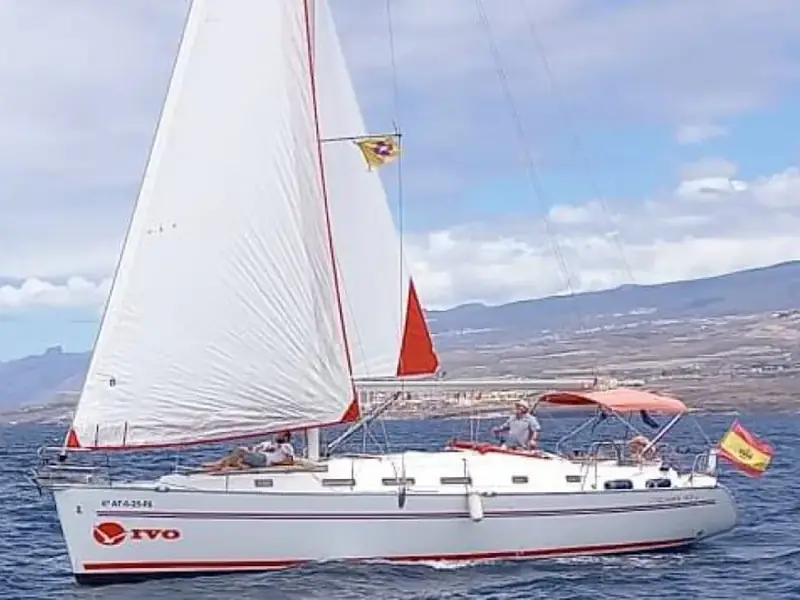
Our sailing yachts Mizendoha, Lina Siete and Madoudou (Puerto Colón) and IVO (Las Galletas) are Barco Azul authorised. Our fifth yacht, SkyLine 1, is not used for whale watching: it sails coastal charters only and stays out of the whale area — which is exactly how the system is meant to work.
With a maximum of 11 guests on a quiet sailing yacht, we see pilot whales on almost every trip and bottlenose dolphins on about half of them. Never guaranteed, always by the rules.
- Small-group whale watching — 3 hours from Puerto Colón, Costa Adeje, at 09:30, 12:30 and 15:30. €49 per adult, €39 per child (0–10), with a swim stop, snorkel gear, sandwich, fruit and drinks.
- Private whale watching — the whole yacht for up to 11 guests, €399 for 3 hours.
- From Las Galletas — private 3-hour trip on IVO, €325 per yacht.
- Coastal charter on SkyLine 1 — €215 for 3 hours, coast and swimming, no whale area.
Sources: Government of the Canary Islands, Decree 178/2000 of 6 September regulating cetacean observation activities (BOC no. 133, 6 October 2000); Royal Decree 1727/2007 on measures for the protection of cetaceans (BOE, 12 January 2008); Spanish Ministry for the Ecological Transition (MITECO), recreational cetacean observation and communication of 26 September 2023 on Teno-Rasca; Hello Canary Islands (official Canary Islands tourism site); Turismo de Tenerife, Sustainability Charter for Whale Watching.