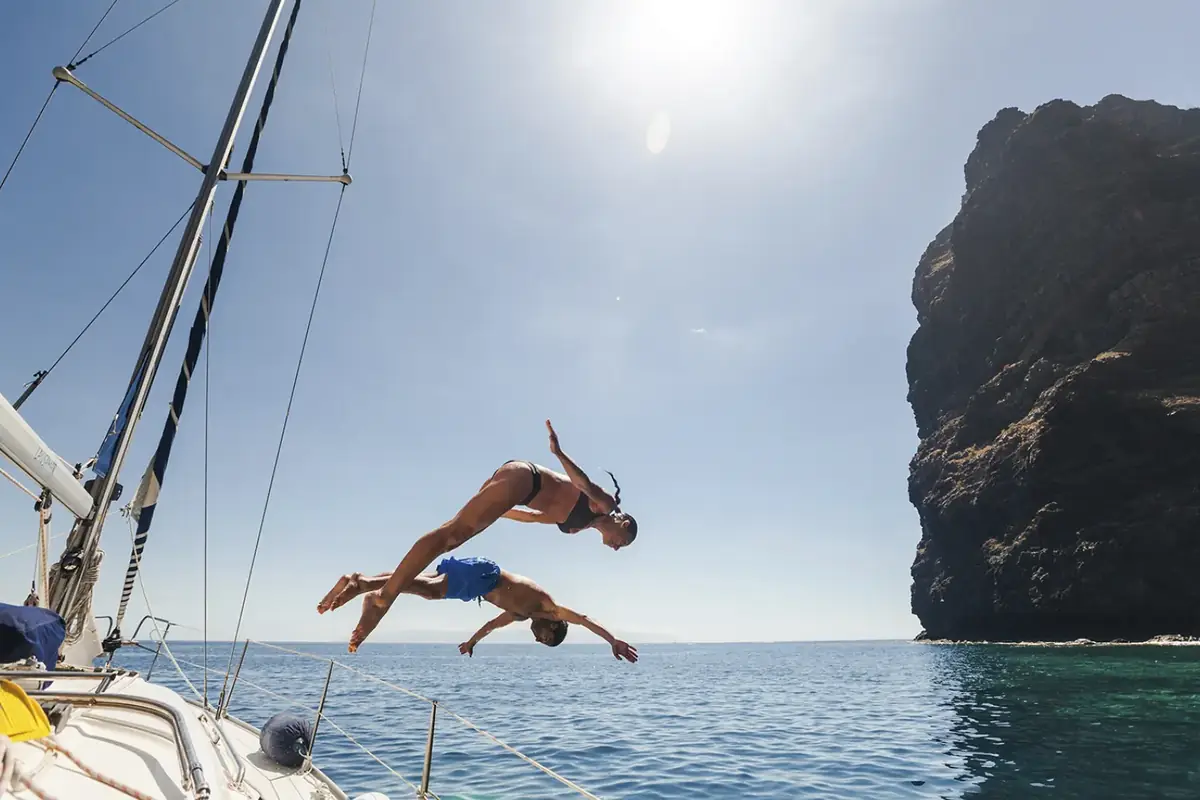

No — you cannot swim with wild dolphins in Tenerife. Spanish law bans bathing or diving within 60 metres of any whale or dolphin, and the Canary Islands’ official guidance is just as clear: it is forbidden to swim with cetaceans, to feed them or to touch them. What you can do is watch dolphins and pilot whales from a licensed boat at a respectful distance, and then swim and snorkel in a quiet bay — two separate parts of the same trip.
This guide is about wild dolphins at sea: what exactly the rules say, why they exist, and what a good day on the water looks like without breaking them.
What the law says
Two sets of rules apply off Tenerife.
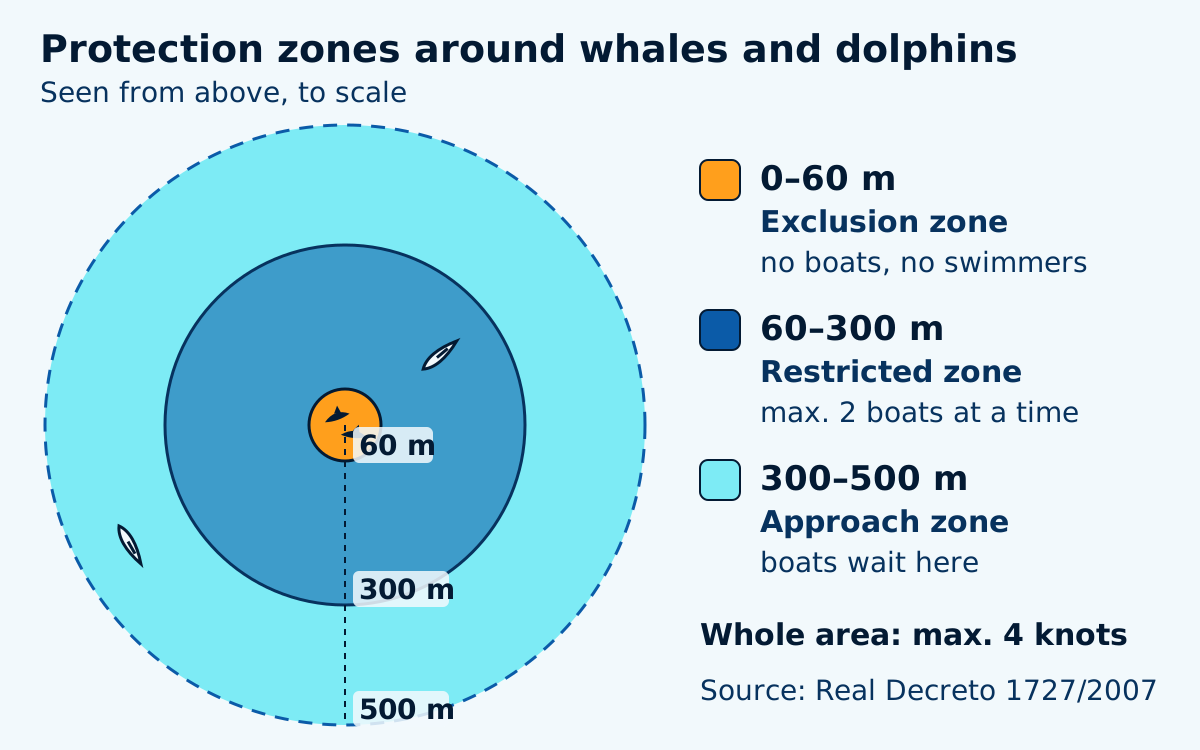
Spain: Royal Decree 1727/2007. This national decree protects every whale and dolphin in Spanish waters. It draws an imaginary “mobile protection space” with a radius of 500 metres around any animal or group, and divides it into zones:
- 0–60 m — exclusion zone. Nobody enters: no boats, no swimmers, no divers. The decree lists “bathing or diving in the exclusion zone” among the prohibited acts.
- 60–300 m — restricted zone. No more than two boats at the same time.
- 300–500 m — approach zone. Other boats wait here for their turn.
Inside the whole space boats must keep a steady speed of no more than 4 knots. Physical contact with the animals, feeding them and throwing anything into the water are also prohibited.
Canary Islands: Decree 178/2000. The regional decree regulates whale watching as a business. Only authorised boats — the ones flying the yellow Barco Azul flag — may take guests to see cetaceans, and they must keep at least 60 metres away, stay no longer than 30 minutes with the same group and never let guests swim with or feed the animals.
The national rules are not only for tour boats. They apply to everyone in Spanish waters: private yachts, jet skis, kayaks and swimmers.
Why swimming with dolphins is banned
The dolphins and pilot whales off south-west Tenerife are not passing through. Many of them live here, in the protected Teno-Rasca marine area, and meet boats every day of the year. Small disturbances add up.
- Rest. During the day pilot whales are often resting at the surface after hunting in deep water. The US agency NOAA, explaining its own ban on swimming with Hawaiian spinner dolphins, notes that dolphins can be asleep while they still look active — they rest half of the brain at a time and keep swimming slowly.
- Behaviour. According to NOAA, frequent close encounters with people have been linked in some dolphin populations to animals abandoning their habitat and to lower breeding success.
- Noise and stress. The Canary Islands’ tourism board points out that cetaceans communicate by sound, that engine noise distorts their “messages”, and that too many boats can cause stress.
- Your safety. A bottlenose dolphin is a large, powerful wild predator. What looks like friendliness can be a sign of disturbance or aggression, NOAA warns.
In short: the rule protects the animals’ home, and it protects you.
“But I saw a tour that offers it”
Sometimes adverts or videos suggest that you can jump in with whales or dolphins in Tenerife. No authorised operator can offer that. A simple check before you book:
- the boat flies the yellow Barco Azul flag;
- the crew explains the distance rules before you reach the animals;
- nobody promises that you will touch, feed or swim with them.
The rules are enforced. In December 2021, for example, the Canary Islands police inspected 18 boats in the Teno-Rasca area and opened seven proposals for sanctions, four of them for operating without a whale-watching authorisation.
What you can do instead
Watch them from a quiet boat
From the deck of a sailing yacht you see dolphins the way they actually live: travelling, hunting, playing with each other. Sometimes the animals decide to come closer on their own, and that is their choice to make.
On our trips from Puerto Colón we see short-finned pilot whales on almost every outing and bottlenose dolphins on about half of them. They are wild animals, so no sighting is ever guaranteed. More about them in our guides to pilot whales in Tenerife and the species you can see here.
Swim and snorkel at Diego Hernández
Swimming is still part of the day — just not with the cetaceans. After the whale watching we sail back along the coast and, when the sea allows, anchor at Diego Hernández beach for about 30 minutes. You can swim from the yacht or snorkel along the rocks; masks and snorkels are on board.
If a dolphin turns up while you are in the water
It is rare, but dolphins go where they like. The national decree covers this too: people in the water must not interact with the animals and should move away as soon as it is safely possible. In practice: stay calm, do not swim towards them, do not try to touch them, return to the boat and follow the crew’s instructions.
Book a trip that does it the right way
- Small-group whale watching — 3 hours from Puerto Colón, Costa Adeje, daily at 09:30, 12:30 and 15:30. €49 per adult, €39 per child (0–10), up to 11 guests. Sandwich, fruit, drinks, snorkel gear and the swim stop are included.
- Private whale watching — the whole yacht for your group, €399 for 3 hours, up to 11 guests.
- From Las Galletas — private 3-hour trip on IVO in the far south, €325 per yacht.
Sources: Real Decreto 1727/2007 on protection measures for cetaceans (BOE, Spain); Decreto 178/2000 on whale-watching activities (Government of the Canary Islands); Spanish Ministry for the Ecological Transition (MITECO), recreational cetacean watching; Hello Canary Islands (official tourism), “Happy cetaceans”; NOAA Fisheries, “Six Reasons Why You Should Not Swim with Wild Spinner Dolphins”, 2021; RTVC / Government of the Canary Islands, whale-watching inspections, December 2021.