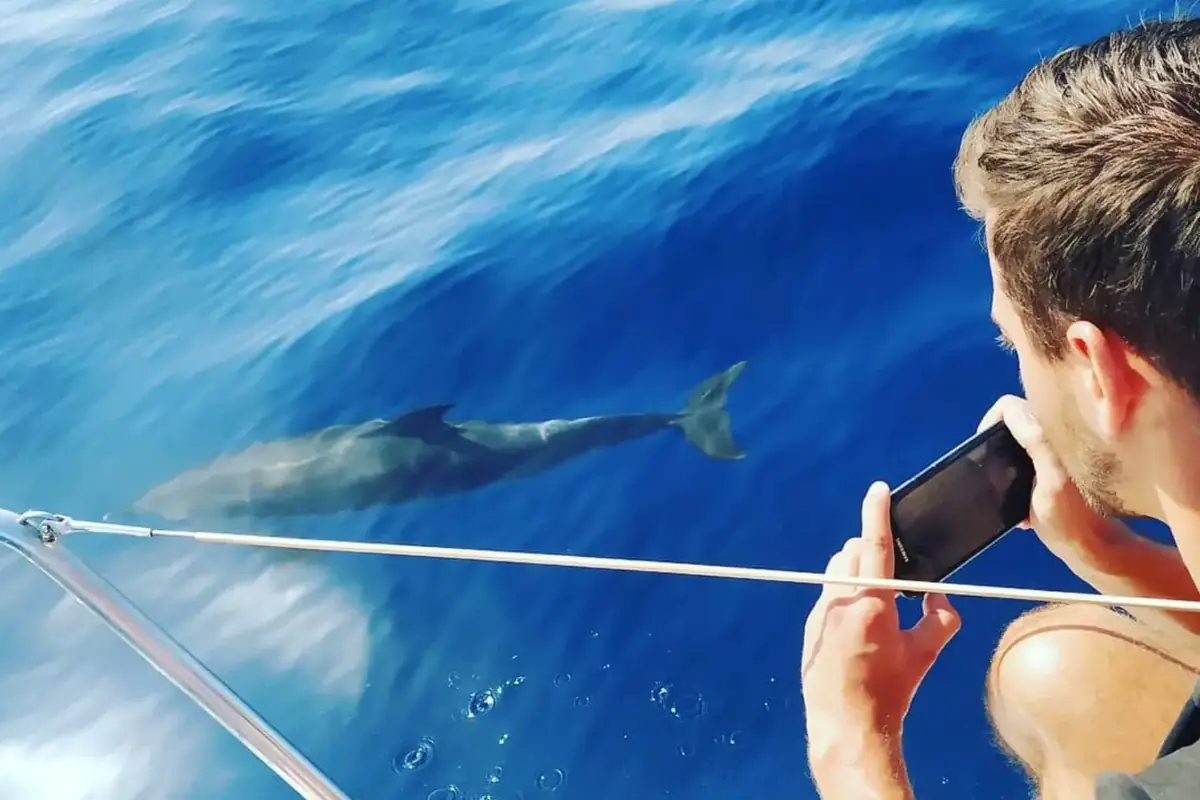

Yes — bottlenose dolphins live off the south-west coast of Tenerife all year round. The common bottlenose dolphin (Tursiops truncatus) is the island’s second resident cetacean after the short-finned pilot whale: according to Spain’s Ministry for the Ecological Transition, both species keep resident populations in the protected Teno-Rasca marine area throughout the year. On our trips from Puerto Colón we meet pilot whales on almost every outing and bottlenose dolphins on about half of them.
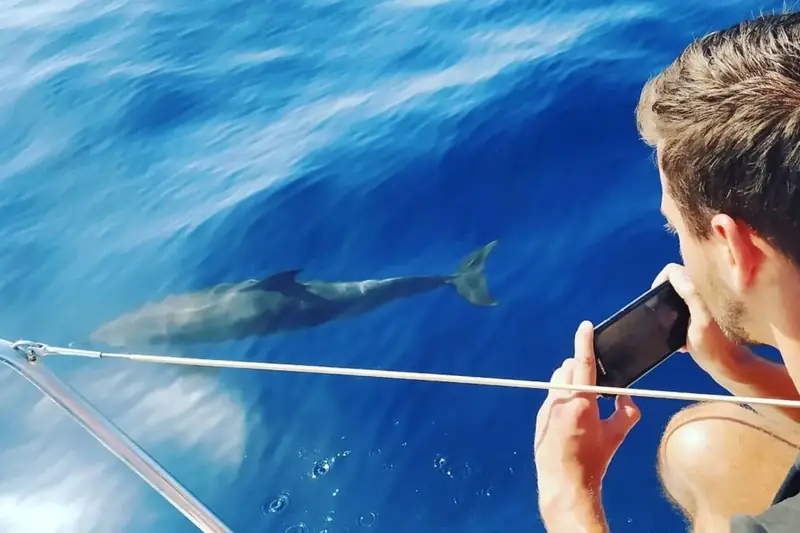
This guide explains how to recognise a bottlenose dolphin, how it differs from a pilot whale, what scientists know about the dolphins of Tenerife and what your real chances of seeing them are.
How to recognise a bottlenose dolphin
This is the “classic” dolphin most people picture. From the deck, look for:
- a grey body — darker on the back, fading to pale grey or almost white on the belly;
- a short, thick beak, which gives the species its name;
- a tall, curved dorsal fin in the middle of the back;
- quick, energetic movement: several fins breaking the surface at once, sometimes a leap.
Adults measure roughly 2 to 4 metres and, according to the US agency NOAA, weigh between about 135 and 635 kg. Dolphins that live near the coast are often smaller and lighter in colour than those of the open ocean. Bottlenose dolphins can live for 40 years or more, and some females reach 60.
Bottlenose dolphin or pilot whale?
Both species belong to the dolphin family, and both live here all year, but at sea you can tell them apart within a few seconds.
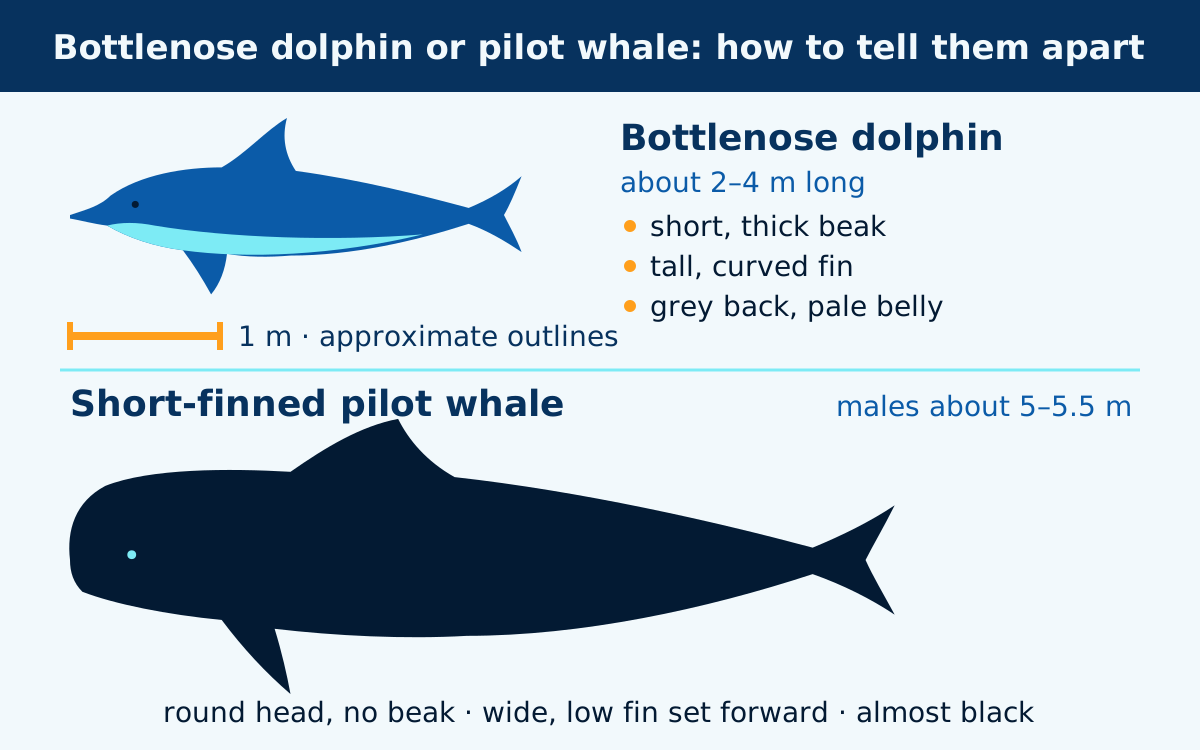
| Bottlenose dolphin | Short-finned pilot whale | |
|---|---|---|
| Size | about 2–4 m | males about 5–5.5 m, females 3.5–4 m |
| Colour | grey, pale belly | dark, almost black |
| Head | short, thick beak | round forehead, no beak |
| Dorsal fin | tall and curved, mid-back | wide and low, set forward |
| At the surface | fast, active, often changing direction | often resting or travelling slowly |
| How often we see them | on about half of our trips | on almost every trip |
More about the larger neighbour in our guide to pilot whales in Tenerife.
How many are there — and do they really live here?
Counting dolphins is hard, so treat every figure as an estimate.
- About 122 at any one time. A boat survey along fixed lines between December 2001 and September 2002 (Carrillo, Peña and Tejedor, 2003) estimated around 122 bottlenose dolphins present off south-west Tenerife, with a likely range of 78 to 193. The authors stress that this is the average number in the surveyed area, not the whole population.
- 129 adults known by their fins. In 2005 and 2006 researchers photographed dolphins from whale-watching boats along the south-west coast, from Masca bay southwards (Verme and Iannacone, 2012). Each animal can be recognised by the nicks and scars on its dorsal fin. They identified 129 adults; 70 of them — a little over half — were seen in both years and counted as residents.
- Some travel. Photo catalogues from different islands have matched the same individuals, which shows that bottlenose dolphins also move between the Canary Islands (Tobeña and colleagues, 2014).
So the honest picture is a core of dolphins that stay around south-west Tenerife, plus others that come and go.
Small groups that keep changing
Pilot whales live in stable families. Bottlenose dolphins are different: scientists call their society fission–fusion. Groups split and merge again, sometimes several times in one day.
In the 2005–2006 study most groups had between 2 and 10 dolphins, around 7 on average, and only occasionally about 50. Groups were mostly made up of females and their young, while males moved in and out. The strongest bonds recorded were between females.
Calves in that study were seen from June to November, most often in August. A pregnancy lasts about 12 months, the mother nurses her calf for around 20 months, and the young dolphin usually stays with her for 3 to 6 years, NOAA notes. A calf swims just behind and beside its mother — easy to spot from a quiet boat.
What they eat and how they hunt
Bottlenose dolphins are flexible hunters. They eat fish, squid and crustaceans, find their prey by listening and by echolocation — high-frequency clicks that bounce back from objects — and often work together, herding fish into a tight school and taking turns to swim through it. They do not chew: fish are swallowed whole, head first.
This is also why you should never feed a wild dolphin. NOAA lists illegal feeding and harassment among the threats to the species, next to fishing gear, noise and collisions with boats.
What are your chances of seeing them?
On our trips from Puerto Colón we see pilot whales on almost every outing and bottlenose dolphins on about half of them. No sighting is ever guaranteed — these are wild animals in open sea.
The numbers above explain the difference. There are fewer bottlenose dolphins than pilot whales, they travel in small groups that keep moving, and they do not spend long hours resting at the surface in the same area. Some days they cross our course in the first twenty minutes; other days they are simply somewhere else.
Because they live here all year, there is no “dolphin season”. A calm sea helps more than a particular month — see our guide to the best time for whale watching in Tenerife.
Sometimes dolphins decide to come closer and swim alongside the yacht, as in the photo at the top of this page. That is always their choice. The boat keeps its course and speed, and nobody gets into the water: swimming with dolphins is not allowed in Tenerife.
A protected species
The bottlenose dolphin is listed in Annexes II and IV of the EU Habitats Directive and is classed as “Vulnerable” in the Spanish Catalogue of Threatened Species. Its home off Tenerife lies largely inside the Teno-Rasca Special Area of Conservation, declared in 2011, which covers almost 70,000 hectares of sea along the west and south-west coast.
On the water this means clear rules for every authorised boat (the Barco Azul licence):
- keep at least 60 metres from the animals;
- stay no longer than 30 minutes with the same group;
- no swimming with, touching or feeding them.
A sailing yacht with a small group of up to 11 guests makes these rules easy to follow: it is quiet, slow and gives everyone a clear view from the deck.
See the dolphins of Tenerife
- Small-group whale watching — 3 hours from Puerto Colón, Costa Adeje, daily at 09:30, 12:30 and 15:30. €49 per adult, €39 per child (0–10), up to 11 guests. Sandwich, fruit, drinks, snorkel gear and a swim stop at Diego Hernández beach are included.
- Private whale watching — the whole yacht for your group, €399 for 3 hours, up to 11 guests.
- From Las Galletas — private 3-hour whale and dolphin trip on IVO in the far south, €325 per yacht.
Sources: Spanish Ministry for the Ecological Transition (MITECO), Teno-Rasca SAC information panel and bottlenose dolphin species sheet; NOAA Fisheries, Common Bottlenose Dolphin; Carrillo, Peña & Tejedor (2003), population size of pilot whales and bottlenose dolphins off SW Tenerife; Verme & Iannacone (2012), Ecología Aplicada 11(2); Tobeña et al. (2014), African Journal of Marine Science; Canary Islands whale watching regulations.