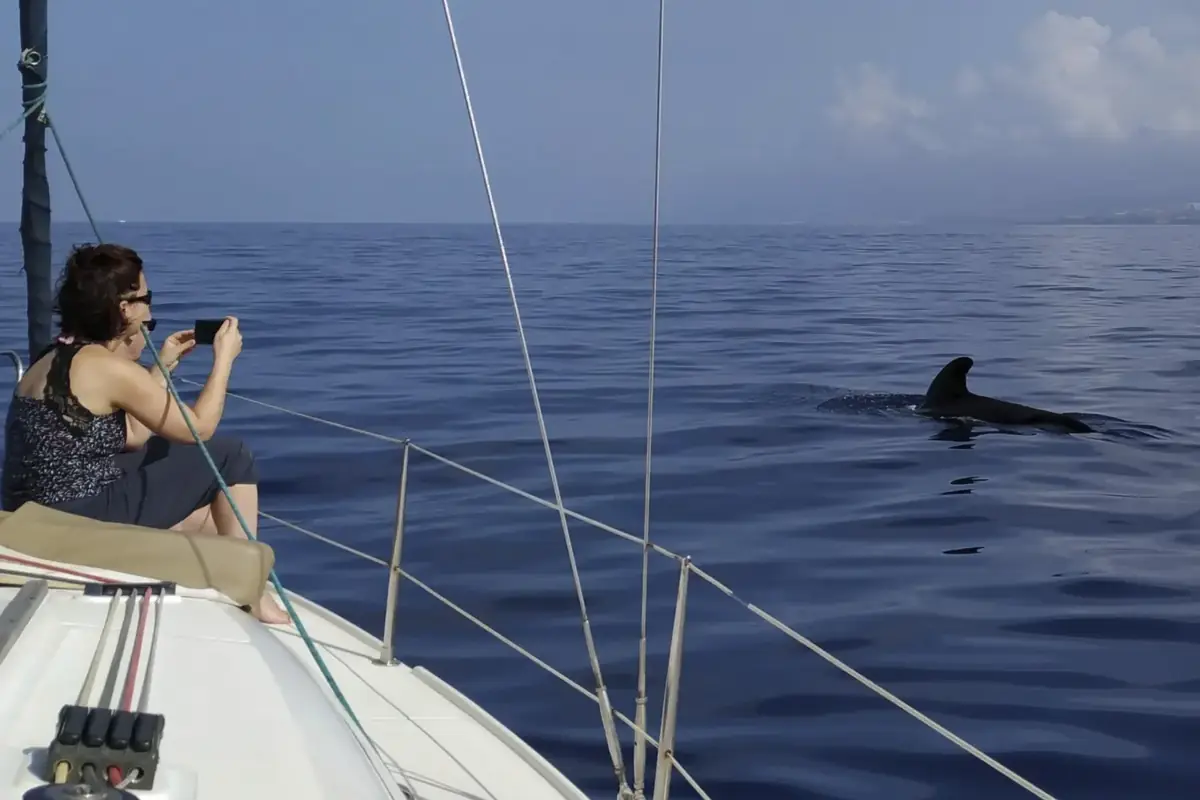

The best time for whale watching in Tenerife is any month of the year. Short-finned pilot whales live off the south-west coast all year, so there is no off-season and no need to plan your holiday around a migration. What changes is the sea, the temperature and the light: if you can choose, the 09:30 departure usually has the calmest water, and the 15:30 departure has the softest light for photos.
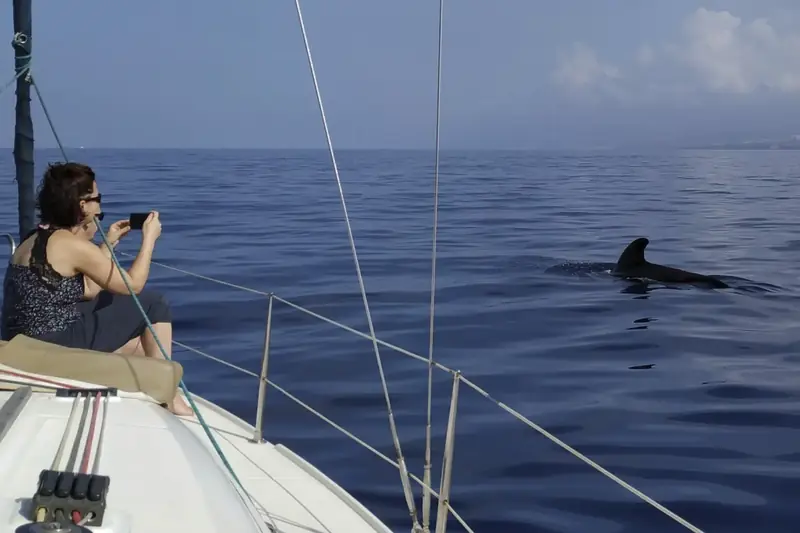
Why Tenerife has no whale-watching season
In many parts of the world, whale watching follows a migration: the animals arrive for a few months and then leave. Tenerife works differently. Long-term research across the Canary Islands, covering 1999 to 2012, recorded short-finned pilot whales all year round and identified a core group of resident animals associated with Tenerife, alongside others that range much more widely.
Bottlenose dolphins live here too. On our trips from Puerto Colón we see pilot whales on almost every outing and bottlenose dolphins on about half of them. They are wild animals, so no sighting can ever be guaranteed, but no month is the wrong month.
You can read more about the animals themselves in our guides to pilot whales in Tenerife and the species you can see here.
Month by month: what actually changes
The seasons in south Tenerife are gentle. The chart shows the general pattern; all values are approximate.
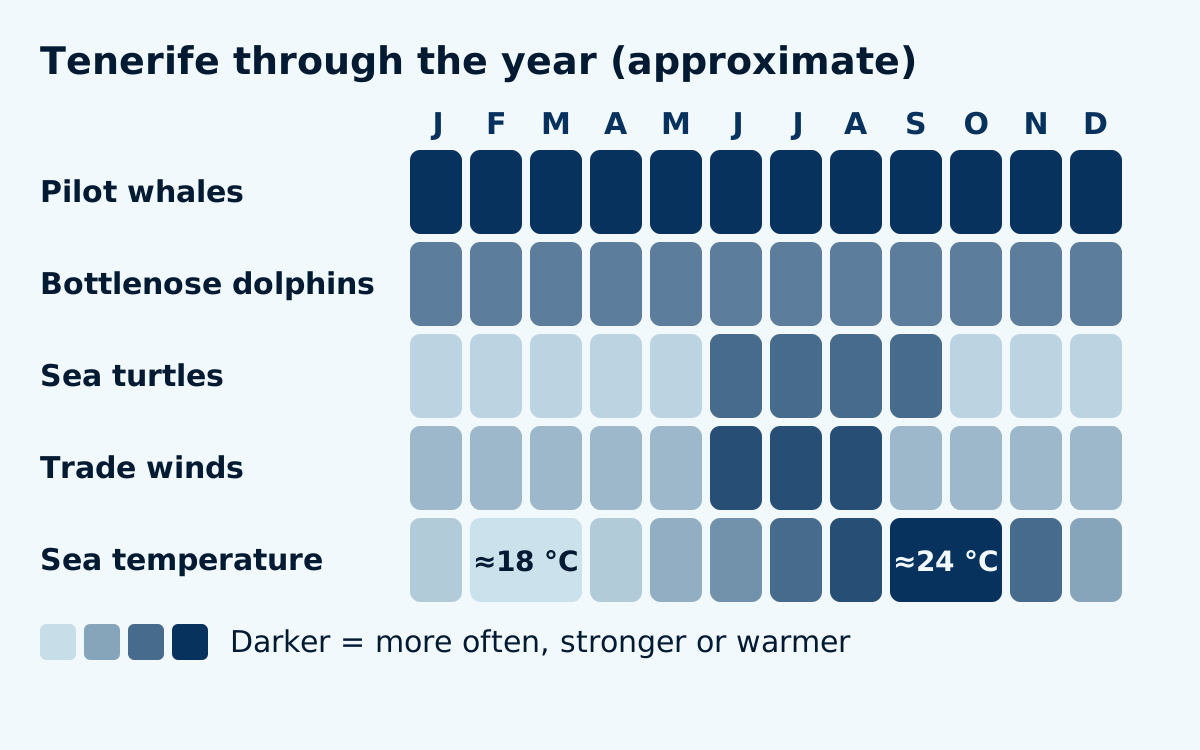
December to March. Daytime highs are around 21–23 °C. The sea is at its coolest, about 18 °C in February and March, so the swim stop is refreshing rather than warm. It is cooler on the water than on land, so bring a light jacket.
April and May. Highs reach around 23–24 °C and the sea slowly warms. Spring may also slightly improve your chance of a bonus visitor. Bryde’s whale, the most common baleen whale in the Canaries, is a seasonal visitor to these islands, and one study off El Hierro recorded its highest rate of visual sightings in spring. Treat this as luck rather than a reason to choose a month: acoustic detections in the same study did not differ between seasons.
June to September. This is the warmest stretch, with highs around 25–28 °C. The north-east trade winds are at their strongest in June, July and August. South-west Tenerife lies in the shelter of the island, so the sea is often calmer here than on the north coast, but summer is a good moment to pick a morning trip if you want flat water. Sea turtles appear on some of our trips, mostly in summer.
October and November. Highs are still around 24–26 °C, and the sea is at its warmest in September and October, about 24 °C. If the swim stop matters as much to you as the whales, this is a lovely time of year.
What is the best time of day?
We sail three times a day, and every trip lasts 3 hours. The whales do not keep to a timetable: pilot whales are often seen resting at the surface or travelling slowly during the day, and we cannot honestly say that one departure has more whales than another. The difference is the sea and the light.
| Departure | Back around | Why choose it |
|---|---|---|
| 09:30 | 12:30 | Usually the calmest sea: the easiest spotting and the smoothest ride |
| 12:30 | 15:30 | Suits a slower morning. The sun is high, so bring sunscreen and a hat |
| 15:30 | 18:30 | The softest light for photos, and a late start after a day at the beach |
Calm water matters more than you might think. A dorsal fin is a small thing to find among waves, and scientists have measured the effect: in a NOAA analysis of ship surveys, the chance of spotting beaked whales on the survey line fell to less than 10% of its calm-sea level by Beaufort 5. Pilot whales are far easier to see than beaked whales, which is why we find them in most conditions, but the principle holds: flatter sea, easier spotting.
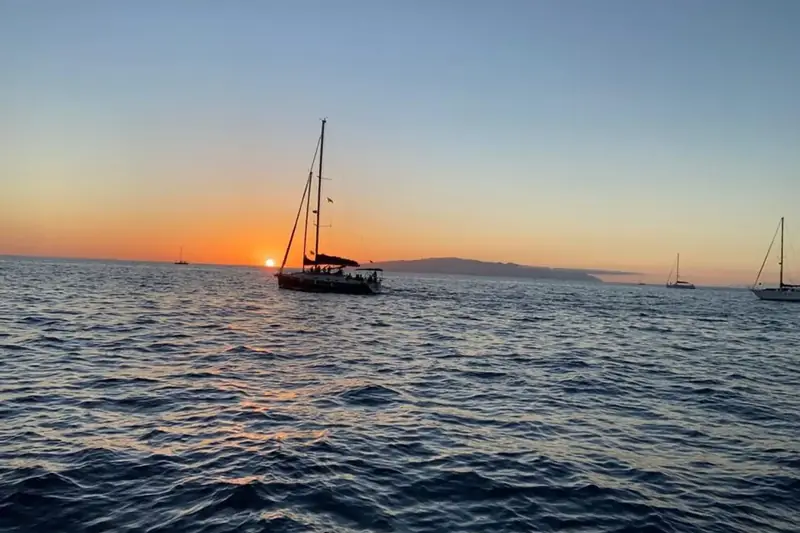
In the shortest days of the year, from about mid-November to mid-January, the sun sets around 18:15–18:30, so the end of the 15:30 trip can run into sunset. For the rest of the year the sun is still up when you return. If the sunset itself is the point, we also run a separate private sunset trip from about 18:00 to 21:00.
How to pick your day
- Go early in your holiday. If the captain cancels because of weather or sea conditions, you choose another date or a full refund. A few spare days make rebooking easy.
- Prone to seasickness? Choose the 09:30 departure and take a tablet beforehand if you usually need one.
- Bring sunscreen, a hat, sunglasses, a light jacket, swimwear and a towel, in any month.
- Expect the same rules all year. Our whale-watching yachts hold the Barco Azul licence, keep at least 60 metres from the animals, stay no more than 30 minutes with a group and never let guests swim with them.
After the whales, when the sea allows, we anchor near Diego Hernández beach for about 30 minutes of swimming and snorkelling.
Book your whale-watching trip
- Small-group whale watching — 3 hours from Puerto Colón, Costa Adeje, daily at 09:30, 12:30 and 15:30. €49 per adult, €39 per child (0–10), up to 11 guests.
- Private whale watching — the whole yacht for your group, €399 for 3 hours, up to 11 guests.
Sources: Servidio et al., “Site fidelity and movement patterns of short-finned pilot whales”, Aquatic Conservation, 2019; Fernández Rodilla, seasonal presence of Bryde’s whale off El Hierro, Universidad de La Laguna, 2022; “Bryde’s whales in the North-East Atlantic”, Aquatic Conservation, 2021; Barlow, NOAA Technical Memorandum NMFS-SWFSC-508, 2013; Web Tenerife climate data; Hello Canary Islands (official tourism) on the trade winds; C. Troupin, Canary Islands sea surface temperature from NASA MODIS data.