

Tenerife is one of the most fascinating places in Europe to discover whales and dolphins in the wild. The waters surrounding the island can host up to 21 different species of cetaceans, from resident short-finned pilot whales and bottlenose dolphins to much rarer visitors such as blue whales, humpback whales and orcas.
For visitors, however, there is an important distinction to make: not every species is equally likely to be seen.
Some cetaceans live around Tenerife throughout the year. Others appear only occasionally or during particular seasons. And a few are rare visitors that even experienced sailors may encounter only exceptionally.
So, what whales can you realistically see in Tenerife?
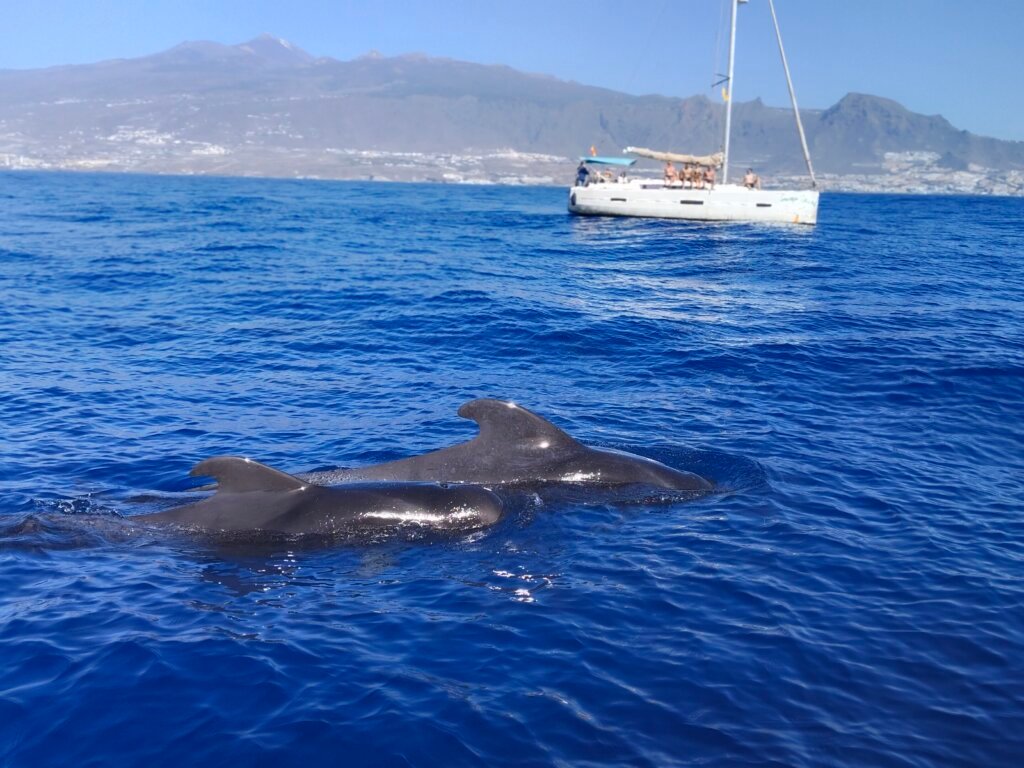
Tenerife is one of the most reliable places in Europe for whale and dolphin watching because of the conditions found around the island’s southwest coast.
The deep Atlantic waters between Tenerife and La Gomera provide an important habitat for cetaceans, including resident populations of short-finned pilot whales and bottlenose dolphins.
Because these animals can be found around Tenerife throughout the year, whale watching here is not limited to a short seasonal window. This makes South Tenerife especially attractive for visitors who want to experience marine wildlife during almost any month of the year.
Ports such as Puerto Colón in Costa Adeje also make these waters easy to reach for travellers staying in the main resorts of the south.
At the same time, the ocean remains completely natural and unpredictable. The presence of resident cetaceans improves the chances of seeing marine life, but it never means that a particular species or sighting can be guaranteed.
If you join a whale-watching trip from Costa Adeje, the short-finned pilot whale (Globicephala macrorhynchus) is one of the most characteristic cetaceans you may encounter.
Pilot whales can grow to more than five metres in length and are easy to recognise by their dark bodies, curved dorsal fins and distinctive rounded foreheads.
What makes them especially important for Tenerife is that they are considered a resident species. Unlike migratory whales that only pass through the Canary Islands at certain times of year, short-finned pilot whales can be found around southwest Tenerife throughout the year.
This is one of the main reasons whale watching is possible year-round in the area between Tenerife and La Gomera.
They are also highly social animals and are often seen travelling in groups, which can make an encounter particularly memorable when several individuals surface close to one another.
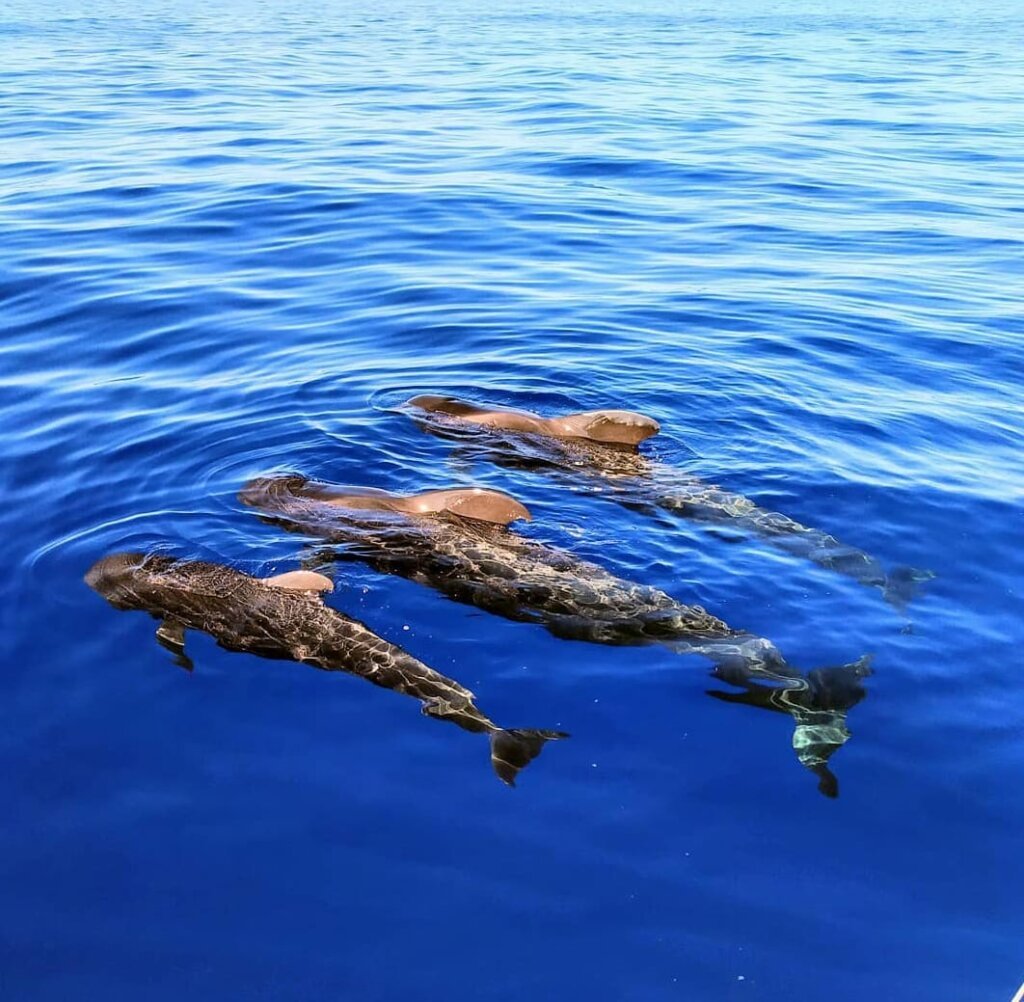
Despite their name, pilot whales are actually members of the dolphin family, Delphinidae.
They are toothed cetaceans, or odontocetes, just like dolphins and sperm whales. Their common name comes from their large size and whale-like appearance.
This makes short-finned pilot whales especially interesting for visitors: they look and behave like large whales, but scientifically they are among the largest members of the dolphin family.
For many guests, this is one of the most surprising facts they learn during a whale-watching trip in Tenerife.
Short-finned pilot whales are the most characteristic cetaceans around southwest Tenerife, but they are not the only whales that may be seen in the island’s waters.
Depending on the season, sea conditions and natural movement of the animals, visitors may also encounter several larger whale species. Some are seen occasionally throughout the year, while others are seasonal or migratory visitors.
Among the most notable species recorded around Tenerife are Bryde’s whales, sperm whales, fin whales and sei whales.
Each of these species has a different pattern of presence around the Canary Islands, which is why no two whale-watching trips are exactly the same.
Bryde’s whales (Balaenoptera edeni) are among the larger baleen whales that may occasionally be seen in the waters around Tenerife.
They can reach around 15 metres in length and are recognisable by the three distinct ridges running along the top of the head. Their bodies are long and streamlined, with a dark grey back and a lighter underside.
Unlike the resident short-finned pilot whales, Bryde’s whales are not encountered with the same regularity. Their presence around Tenerife is more sporadic, which makes every sighting particularly special.
Because they are wild animals moving freely through the Atlantic, seeing a Bryde’s whale should be considered a fortunate encounter rather than something that can be expected on every trip.
Sperm whales (Physeter macrocephalus) are among the most impressive cetaceans that can be encountered around Tenerife.
They are the largest toothed whales in the world and are easy to recognise by their enormous rectangular heads, dark wrinkled skin and relatively small dorsal fins.
Sperm whales are extraordinary deep divers. They can spend long periods underwater while searching for squid and other prey at great depths, which means sightings at the surface can be brief and unpredictable.
Around Tenerife, sperm whales are not considered a resident species in the same way as short-finned pilot whales, but they are recorded in the surrounding Atlantic waters and may occasionally be seen during whale-watching trips.
An encounter with a sperm whale is therefore something special rather than something that should ever be guaranteed.
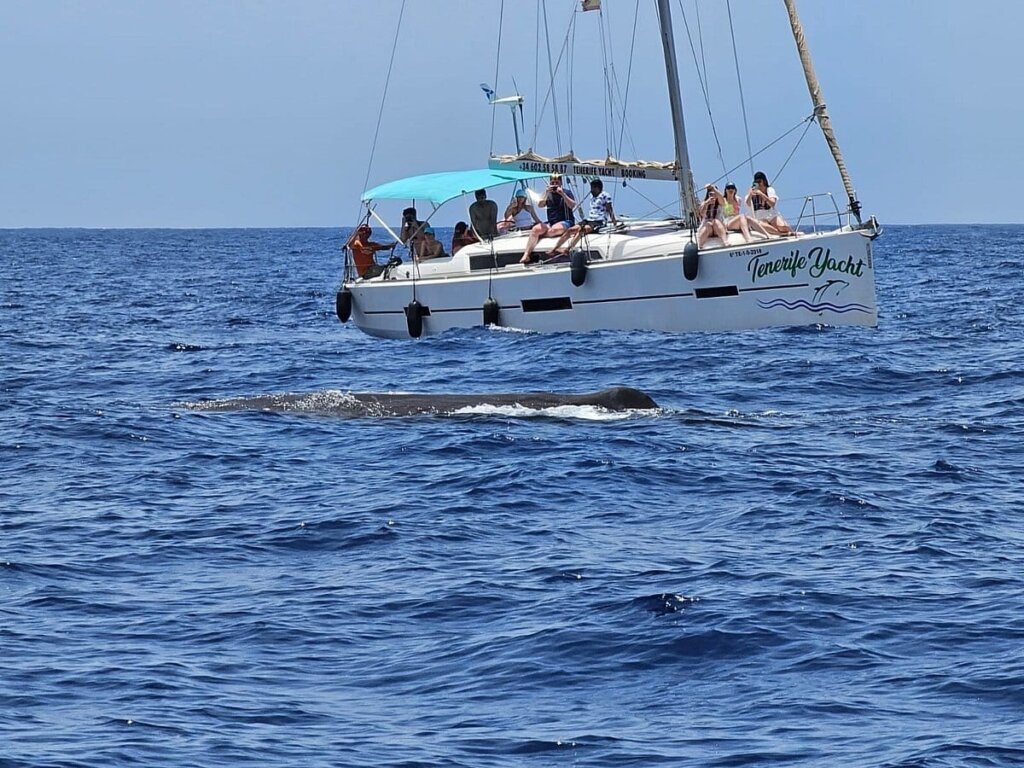
Fin whales (Balaenoptera physalus) and sei whales (Balaenoptera borealis) are among the larger baleen whales that may pass through the waters around Tenerife.
Fin whales are one of the largest animals on Earth, with long, streamlined bodies built for efficient movement through the open ocean. Sei whales are slightly smaller but are also fast-swimming, migratory whales.
Unlike short-finned pilot whales, these species are not resident around southwest Tenerife. They are considered seasonal or migratory visitors, so sightings are much less predictable.
When they do appear, they can turn an ordinary whale-watching trip into a rare and memorable wildlife
One of the reasons Tenerife is so fascinating for marine-life enthusiasts is the variety of cetaceans that have been recorded in the waters around the island.
Some species are only seen occasionally, and for many visitors they would be considered a very rare encounter.
These include blue whales, humpback whales, minke whales, orcas and several species of beaked whales.
It is important to keep these sightings in perspective. These animals are not resident around southwest Tenerife in the same way as short-finned pilot whales, and they should never be presented as something visitors are likely to see on a normal excursion.
A rare sighting is exciting precisely because it is unexpected.
For responsible whale watching, it is better to set realistic expectations and allow nature to surprise you.
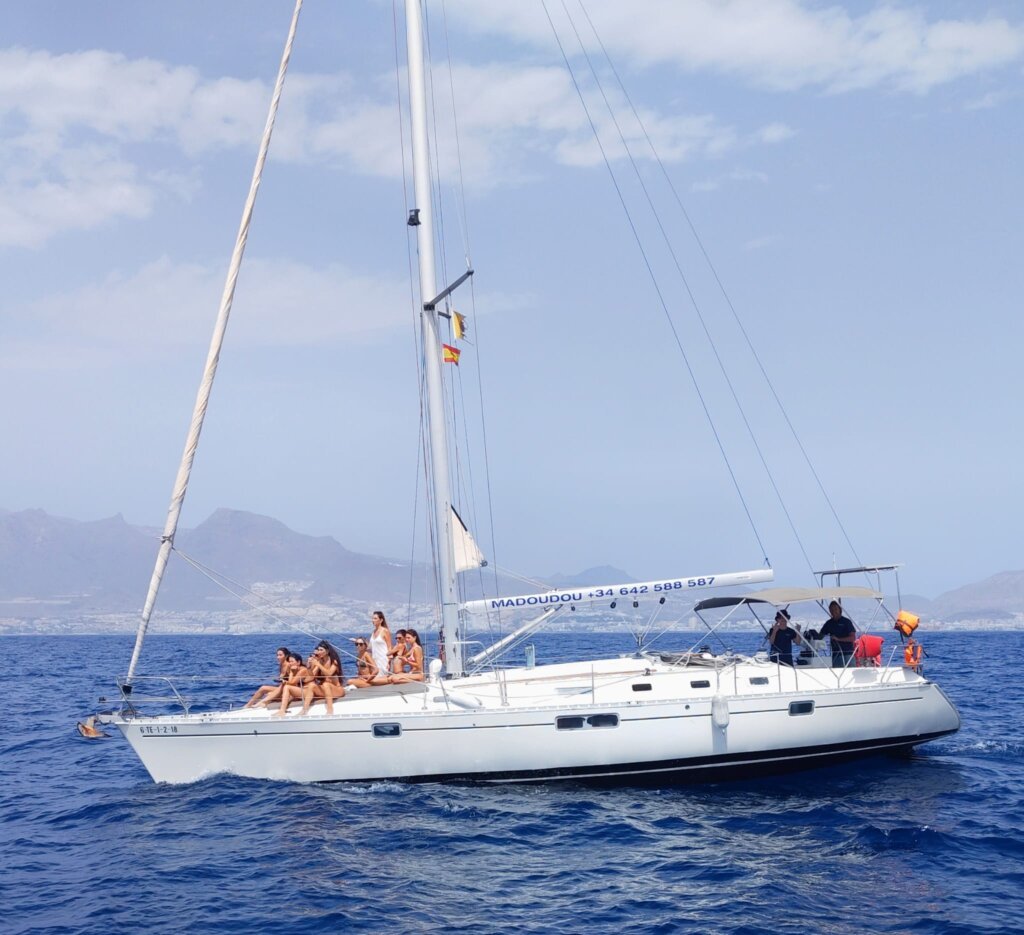
Whale watching is very different from visiting an aquarium or a controlled wildlife attraction.
At sea, the first sign of a cetacean can be surprisingly subtle. It may be a dark dorsal fin breaking the surface, a distant splash or a brief movement on the water.
Sometimes several animals surface together. At other times, you may only see one individual before it dives again and disappears beneath the Atlantic.
The next surfacing can happen close to the boat or much farther away, and that unpredictability is part of the experience.
On a small sailing yacht, guests can watch the water from different angles and enjoy the surroundings without the feeling of being part of a large crowd.
Every encounter is different because the animals decide where they go, how long they stay at the surface and when they dive.
That is exactly what makes seeing whales and dolphins in the wild so memorable.

The waters off the south and southwest coast of Tenerife are among the best-known areas for whale and dolphin watching on the island.
For visitors staying in Costa Adeje, Playa de las Américas, Los Cristianos, La Caleta or nearby resorts, Puerto Colón is one of the most convenient departure points.
From Puerto Colón, boats can quickly reach the open Atlantic waters where resident short-finned pilot whales and bottlenose dolphins are frequently found.
The location is especially convenient because it is close to many of South Tenerife’s main hotels, beaches and tourist areas, making it easy to include a whale-watching trip in your day without a long transfer.
The exact route of each trip depends on sea conditions, weather and where marine life is being observed naturally that day.
For travellers who prefer a more personal experience, a small-group sailing trip can be a comfortable way to explore the waters off South Tenerife.
Atlantic Waves departs from Puerto Colón in Costa Adeje and offers a 3-hour sailing experience with up to 11 guests on board.
The trip combines whale and dolphin watching with time to enjoy the Atlantic, and when conditions allow, there is also a stop for swimming and snorkelling.
Included on board:
Departures are scheduled at 09:30, 12:30 and 15:30.
The small-group format is ideal for couples, families and travellers who prefer a more relaxed atmosphere than a large excursion boat.
Whales and dolphins around Tenerife are wild animals living in their natural environment.
They decide where they travel, when they surface, how long they dive and whether they remain in the same area. Sea conditions, weather, feeding behaviour and many other natural factors can influence what happens during each trip.
Even in waters where resident cetacean populations are regularly observed, no responsible operator can control nature or promise a specific encounter.
For this reason, Atlantic Waves does not advertise 100% guaranteed whale or dolphin sightings.
We believe that setting realistic expectations is an important part of responsible wildlife tourism.
And when a whale or dolphin appears beside the boat in the open Atlantic, knowing that the encounter was completely natural is exactly what makes the moment special.
When choosing a whale-watching trip in Tenerife, price and boat size are not the only things worth considering.
A responsible experience should respect the fact that whales and dolphins are wild animals and that their welfare comes before getting as close as possible for a photo.
Good whale-watching practices include keeping a respectful distance, avoiding sudden changes of direction, limiting disturbance and allowing cetaceans to move naturally.
It is also a good sign when an operator is clear about what guests can realistically expect and does not promise guaranteed sightings.
A responsible trip should help visitors enjoy the experience while also understanding more about the animals and the marine environment around Tenerife.
For many travellers, that makes the encounter more meaningful than simply seeing a whale for a few seconds.
Short-finned pilot whales are the cetaceans most commonly associated with whale watching around southwest Tenerife. They are resident in the area throughout the year and are regularly observed during boat trips from Costa Adeje.
Yes. Whale and dolphin watching takes place throughout the year because resident populations of short-finned pilot whales and bottlenose dolphins live around Tenerife. Other species may be seasonal, migratory or only occasionally observed.
Orcas have been recorded in the waters around Tenerife, but sightings are rare. They should not be considered a species visitors are likely to see during a normal whale-watching excursion.
Humpback whales can occasionally occur around Tenerife, but they are rare visitors rather than a resident species. A sighting should be considered an exceptional wildlife encounter.
Yes. Despite their name, short-finned pilot whales belong to the dolphin family, Delphinidae. They are among the largest members of the dolphin family.
Puerto Colón marina in Costa Adeje is one of the main departure points for whale and dolphin watching in South Tenerife. Atlantic Waves departs from Puerto Colón for its small-group sailing trips.
Join a 3-hour small-group sailing experience from Puerto Colón, Costa Adeje. Enjoy the Atlantic with up to 11 guests, drinks, a sandwich and snorkelling equipment included.
Авторизоваться
Пожалуйста, введите ваше имя пользователя или адрес электронной почты. Вы получите ссылку для создания нового пароля по электронной почте.